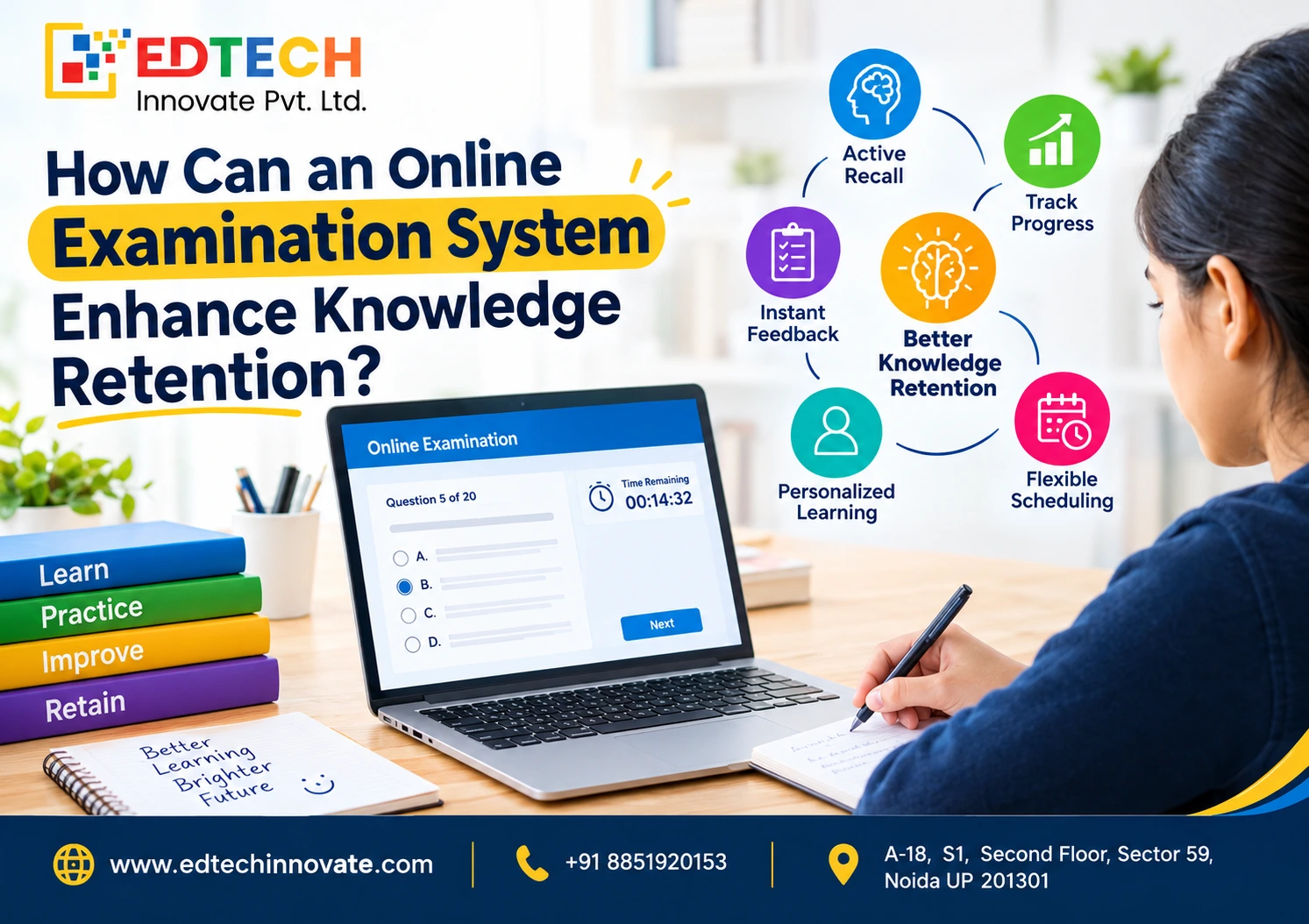
An online examinatio...

Digital education in India has moved from a novelty to a necessity, and an LMS for Schools India is now at the heart of that shift. Since the pandemic accelerated online learning, and with the National Education Policy (NEP) 2020 pushing for technology-driven, outcome-based education, schools across the country are re-evaluating how they teach, assess, and communicate. A Learning Management System (LMS) brings classrooms, assignments, exams, attendance, and parent communication onto a single digital platform, reducing paperwork and improving visibility for teachers, students, and parents alike. Whether a school is a CBSE institution in a metro city or a state-board school in a smaller town, the right LMS can streamline daily operations while improving learning outcomes. This guide walks school owners, principals, and administrators through everything they need to know before choosing an LMS for Schools India — from core features and benefits to pricing, implementation, and future trends.
An LMS, or Learning Management System, is a software platform that allows schools to manage teaching, learning, assessments, and communication in one digital environment. Instead of relying on scattered spreadsheets, printed notices, and physical registers, a school LMS brings lesson delivery, homework, grading, attendance, and parent updates together in one place.
In simple terms, an LMS works like a digital bridge between teachers, students, and parents. Teachers upload study material, assignments, and tests; students access lessons and submit work online; and parents track progress, attendance, and fees — all from a computer or mobile app.
A School ERP (Enterprise Resource Planning) system typically manages administrative functions such as admissions, fee collection, payroll, and inventory. An LMS, on the other hand, focuses on teaching and learning — virtual classrooms, assignments, exams, and academic progress. Many modern platforms combine both, offering school management software with LMS built in, so schools get administrative efficiency and academic delivery in a single system.
Indian schools are increasingly adopting hybrid and blended learning models, where classroom teaching is supported by digital tools. Parents today expect timely updates, students expect interactive and engaging content, and school boards increasingly expect data-backed reporting on academic progress. A school learning management system helps institutions keep pace with these changes while addressing everyday academic and administrative challenges that were previously managed through registers, notice boards, and phone calls.
Beyond convenience, an LMS also helps schools maintain continuity during disruptions such as extreme weather, health emergencies, or infrastructure issues, since lessons, assignments, and assessments can continue online without significant loss of instructional time. This resilience, combined with better day-to-day efficiency, is why online learning platform for schools adoption has grown steadily across CBSE, ICSE, and state board institutions in recent years.
The value of an LMS extends well beyond digitizing existing processes. When implemented thoughtfully, it changes how teaching, learning, and communication happen day to day, delivering measurable benefits across the school community.
Interactive lessons, quizzes, and gamified content keep students more involved than static, one-way teaching methods.
Automated grading, ready-made templates, and centralized content reduce repetitive administrative work for teachers.
Students can revisit recorded lessons and study material anytime, supporting self-paced revision.
Digital records for attendance, exams, and reports reduce dependency on printed registers and files.
Adaptive content and analytics help tailor learning paths to each student's pace and ability.
Instant notifications keep parents informed about attendance, homework, and school events without manual follow-ups.
Cloud-based platforms with role-based access protect sensitive student and academic data.
Automating manual processes lowers administrative overhead and paper-related expenses over time.
LMS pricing in India varies widely depending on school size, feature requirements, and deployment type. Rather than a fixed number, schools should expect a range based on the following factors:
|
School Size |
Typical Deployment |
Estimated Pricing Range (Per Student/Year) |
|
Small (up to 500 students) |
Cloud-based, standard features |
Lower end of market range |
|
Mid-size (500–2000 students) |
Cloud-based, with analytics & app |
Mid-range pricing |
|
Large (2000+ students) |
Cloud or hybrid, full feature set with custom integrations |
Higher end, often negotiated |
Note: These are indicative ranges only. Schools should always request a customized quote based on their exact requirements, as pricing structures differ across vendors.
|
Feature |
Traditional Classroom |
LMS |
|
Attendance |
Manual registers, time-consuming |
Automated, instant digital records |
|
Homework |
Notebooks, easy to lose or forget |
Assigned and submitted online, tracked automatically |
|
Exams |
Paper-based, manual grading |
Online exams with auto-grading for objective questions |
|
Parent Communication |
Diary notes, occasional meetings |
Real-time updates via app and portal |
|
Reports |
Manually compiled report cards |
Auto-generated, data-driven report cards |
|
Learning Analytics |
Little to no data insight |
Detailed performance and progress analytics |
|
Accessibility |
Limited to physical classroom hours |
Available anytime, anywhere |
|
Student Engagement |
Largely one-directional teaching |
Interactive, gamified, and personalized |
Schools that continue to rely entirely on manual processes often find that inefficiencies compound as student strength grows. What may feel manageable with a few hundred students can become overwhelming across multiple sections and grades, particularly when academic and administrative data lives in disconnected registers, spreadsheets, and paper files rather than a single digital learning platform.
A successful LMS rollout depends less on the software itself and more on how well a school plans the transition. Rushed implementations, where teachers and parents are given little time to adapt, are one of the most common reasons digital adoption stalls in the first term. A phased approach — starting with a pilot batch of classes before a full-school rollout — often works better than switching every grade over at once.
As NEP 2020 implementation progresses and schools embrace digital-first strategies, the future of LMS for Schools India will likely be shaped by:
Among the platforms available in the market, eSchool is often considered by institutions looking for an easy-to-implement, user-friendly LMS for Schools India. Schools appreciate eSchool for its straightforward onboarding process, which reduces the learning curve for teachers and administrators during the transition to digital learning.
The platform offers a mobile-accessible interface, allowing teachers, students, and parents to stay connected to classroom activity, assignments, and updates without being tied to a desktop. eSchool also provides tools that support day-to-day teacher workflows, along with student engagement features designed to keep learners interested in digital lessons.
Security is another area where eSchool is frequently mentioned, with a cloud-based platform built to protect academic and student data. Its support for online assessments simplifies exam management, while built-in parent communication tools help schools maintain transparency with families. As schools grow, eSchool's scalable structure allows the platform to expand alongside changing institutional needs, making it a practical option to evaluate when comparing school LMS India providers.
Digital learning is no longer optional for Indian schools — it has become a core part of delivering quality education in line with NEP 2020's vision. Choosing the right LMS for Schools India is a decision that affects teachers, students, and parents for years to come, making careful evaluation essential. From virtual classrooms and online exams to attendance tracking and learning analytics, a well-chosen LMS can simplify daily operations while improving academic outcomes. The long-term benefits — reduced administrative burden, better communication, and data-driven decision-making — far outweigh the effort of switching from traditional methods. As more schools recognize how an LMS for Schools India is transforming education, institutions that evaluate their specific needs, compare features and pricing carefully, and choose a scalable, secure platform will be best positioned for the future of learning.
What is the best LMS for schools in India?
The best LMS depends on a school's size, board, budget, and specific needs. Schools should compare features, pricing, and support across multiple vendors, and request demos before deciding.
How much does an LMS cost for schools in India?
Pricing varies based on student strength, features, and deployment type (cloud vs on-premise). Schools should request customized quotes rather than relying on fixed, one-size-fits-all pricing.
Which schools need an LMS?
Any school — CBSE, ICSE, state board, or K12 — looking to digitize teaching, streamline administration, and improve communication with parents can benefit from an LMS.
Can an LMS integrate with School ERP?
Yes, many modern platforms offer school management software with LMS built in, or provide integrations between standalone LMS and ERP systems.
Is an LMS suitable for CBSE schools?
Yes, LMS platforms support CBSE curriculum delivery, including assignments, exams, and academic reporting aligned with CBSE requirements.
Is an LMS useful for ICSE schools?
Yes, ICSE schools can use an LMS for virtual classrooms, homework management, and structured assessments suited to their curriculum.
Can parents access an LMS?
Most school LMS platforms include a dedicated parent portal or app for tracking attendance, grades, homework, and communicating with teachers.
Does an LMS support online exams?
Yes, online exams software is a standard feature in most school LMS platforms, supporting both objective and subjective question formats.
Is cloud-based LMS better than on-premise LMS?
Cloud-based LMS generally offers easier maintenance, automatic updates, and lower upfront infrastructure costs compared to on-premise systems, though the right choice depends on a school's specific requirements.
How long does LMS implementation take?
Implementation timelines vary by school size and complexity, but typically range from a few weeks to a couple of months, including training and content migration.
Can schools customize their LMS?
Many LMS vendors offer customization options for branding, features, and workflows, though the extent of customization varies by platform.
Does an LMS improve student performance?
By enabling personalized learning, timely feedback, and data-driven insights, an LMS can support improved student performance, though outcomes also depend on how effectively it is used.
Is LMS secure for student data?
Reputable LMS platforms use cloud security measures, role-based access, and data encryption to protect student information, but schools should verify each vendor's specific security standards.
Which features are essential in a school LMS?
Key features include virtual classrooms, assignment management, online exams, attendance tracking, gradebooks, parent portals, mobile access, and learning analytics.
How do I choose the best LMS for my school?
Identify your requirements, set a budget, compare features and pricing across vendors, request demos, check support quality, and verify security and scalability before deciding.