An online examinatio...

Schools and colleges across India are under pressure to move faster than ever — faster admissions, faster fee collection, faster communication with parents, and faster reporting to management. Manual registers, scattered spreadsheets, and disconnected software tools simply can't keep up. This is exactly why Educational ERP Software has become the backbone of modern institutional management. Instead of juggling separate systems for admissions, attendance, exams, and fees, institutions are now switching to unified platforms that bring everything under one roof.
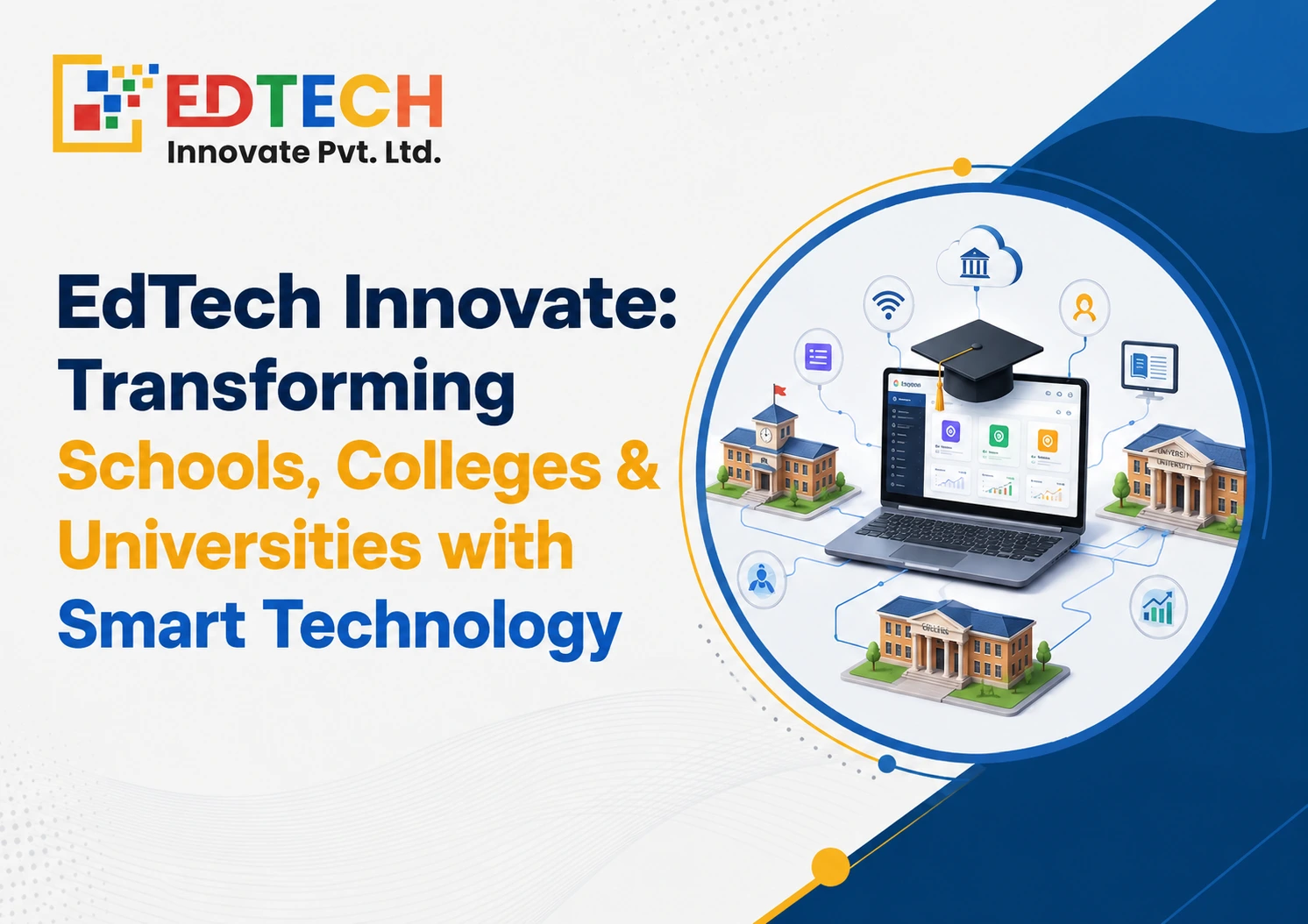
EdTech Innovate was built to solve this exact problem. It combines ERP, LMS (Learning Management System), and CRM (Customer Relationship Management) into a single, cloud-based platform designed specifically for schools, colleges, universities, and coaching institutes. Whether you're managing 200 students or 20,000 across multiple campuses, an integrated system removes duplicate work, reduces errors, and gives every stakeholder — from the principal to the parent — a clearer view of what's happening. In this guide, we'll break down what Educational ERP Software actually does, why it matters, and what to look for before choosing one for your institution.
What is Educational ERP Software?
Educational ERP Software is a digital platform that centralizes and automates the administrative, academic, and financial operations of a school, college, or university. Instead of maintaining separate registers for admissions, attendance, fees, and examinations, an ERP consolidates all of this into one connected database that different departments can access in real time.
Traditionally, institutions relied on paper files, Excel sheets, and manual coordination between departments. This approach is slow, error-prone, and nearly impossible to scale. An ERP replaces this fragmented process with a single source of truth — every student record, fee transaction, attendance entry, and exam result lives in one system, accessible instantly by authorized staff.
At its core, Educational ERP Software performs functions like:
The shift from manual to digital administration isn't a trend — it's becoming a baseline expectation from parents, regulators, and staff. Institutions that continue relying on manual systems tend to fall behind in accuracy, speed, and parent satisfaction.
Here's what a good ERP system brings to the table:
Most ERP providers only cover administrative tasks. EdTech Innovate goes further by combining ERP, LMS, and CRM into one platform, so institutions don't need to buy and integrate three separate tools.
Digitizes the entire admission cycle — from online applications and lead tracking to document verification and seat allocation — reducing admission-season chaos.
Maintains complete student profiles, academic history, and attendance records in one searchable database accessible to authorized staff.
Enables online fee collection, automatic receipt generation, and payment reminders, cutting down on manual follow-ups and late payments.
Supports RFID, biometric, and mobile-based attendance marking, with automatic sync to parent notifications.
Automates marks entry, grade calculation, and report card generation, minimizing manual errors during result season.
Manages staff records, payroll processing, and leave tracking within the same platform used for academic administration.
Tracks vehicle routes, driver assignments, and student pickup/drop schedules.
Digitizes book cataloguing, issue/return tracking, and inventory management.
Manages room allocation, warden records, and hostel fee tracking for residential institutions.
Tracks institutional assets, lab equipment, and stationery stock levels.
The LMS module extends EdTech Innovate beyond administration and into the classroom itself. Institutions can conduct live lectures, share recorded sessions for revision, and assign homework digitally. Students can attempt online tests and quizzes, while teachers get learning analytics that show exactly where a student is struggling.
Admission season is often the most chaotic period for any institution, and this is where the CRM module proves its value. It tracks every inquiry from first contact to enrollment, automates follow-ups so no lead is missed, and keeps parent communication organized across email, SMS, and WhatsApp.
Staff spend less time on repetitive paperwork and more time on tasks that actually need human judgment.
Students get instant access to timetables, results, and study material without waiting on office staff.
Automated notifications keep parents informed about attendance, fees, and academic performance in real time.
Teachers spend less time on manual attendance and grading, freeing up time for actual teaching.
Centralized, access-controlled data storage reduces the risk of lost or tampered records.
Digital applications and CRM-driven follow-ups shorten the admission cycle significantly.
Automated fee tracking and reporting give management a clear, real-time financial picture.
Dashboards and analytics help leadership make decisions based on real numbers, not guesswork.
Pricing for Educational ERP Software depends on several institution-specific factors rather than a fixed number. Below is a breakdown of what typically influences cost:
| Factor | Impact on Pricing |
|---|---|
| Institution size | Larger student bases typically require higher-tier plans |
| Number of students | Per-student or per-user pricing models scale with enrollment |
| Number of campuses | Multi-campus deployment often needs additional licensing |
| Modules required | Choosing only ERP vs. ERP+LMS+CRM changes total cost |
| Cloud vs on-premise | Cloud plans are usually subscription-based; on-premise involves upfront infrastructure cost |
| Customization | Custom workflows or integrations add to implementation cost |
| Support level | Priority or dedicated support may come at a premium |
| Training | Onboarding and staff training sessions can be bundled or charged separately |
Exact pricing varies by institution requirements — contact EdTech Innovate for a customized quote.
EdTech Innovate's mobile app extends the platform to students, parents, and teachers, keeping everyone connected outside the classroom.
| Parameter | Traditional Management | Educational ERP Software |
|---|---|---|
| Data Management | Manual registers, scattered files | Centralized digital database |
| Automation | Minimal to none | Fee reminders, attendance sync, report generation |
| Reporting | Manual compilation, delayed | Real-time dashboards |
| Communication | Notices, phone calls | SMS, email, WhatsApp, app notifications |
| Accessibility | Office hours only | 24/7 access via web and mobile |
| Cost Efficiency | Higher long-term staffing cost | Reduced manual workload, better ROI |
| Security | Vulnerable to physical loss/damage | Encrypted, access-controlled, backed up |
| Scalability | Difficult to scale across campuses | Built for multi-campus growth |
Institutions that adopt EdTech Innovate typically do so because it removes the need to manage multiple disconnected vendors. Everything — admissions, classroom learning, communication, and finance — runs through one platform, which simplifies both training and support.
Educational ERP platforms are moving well beyond basic record-keeping. The next phase of growth is being shaped by artificial intelligence, predictive analytics, and mobile-first design — trends that are already influencing how institutions plan their technology investments.
Institutions relying on manual systems commonly struggle with delayed fee collection, inconsistent attendance records, miscommunication with parents, and slow admission processing. An integrated ERP directly addresses each of these by automating the repetitive parts of the workflow and giving staff a single system to work from instead of ten.
EdTech Innovate is built to serve schools, colleges, universities, and coaching institutes — including single-campus institutions as well as multi-campus education groups that need centralized visibility across locations.
Before signing up with any vendor, institutions should shortlist 2-3 providers, request live demos from each, compare module coverage against actual requirements, and speak with existing customers where possible. This reduces the risk of investing in a system that looks good on paper but doesn't fit day-to-day operations.
Running separate tools for administration, teaching, and admissions means duplicate data entry, higher costs, and integration headaches. A unified platform like EdTech Innovate keeps all departments working from the same data, reducing errors and vendor management overhead.
Ready to see it in action? Request a live demo of EdTech Innovate and see how ERP, LMS, and CRM work together on one platform built for your institution.
Educational ERP Software has moved from a "nice to have" to a core requirement for institutions that want to run efficiently and scale without adding administrative overhead. By combining ERP, LMS, and CRM into a single platform, EdTech Innovate removes the need for multiple disconnected tools and gives schools, colleges, and universities one system to manage admissions, teaching, communication, and finance. As automation and AI continue to shape the future of education technology, institutions that adopt integrated platforms early will be better positioned to handle growth, improve student outcomes, and simplify day-to-day operations. If you're evaluating Educational ERP Software for your institution, EdTech Innovate offers the complete package — ERP, LMS, and CRM — built specifically for the needs of modern educational institutions.
What is Educational ERP Software?
Educational ERP Software is a digital platform that centralizes and automates a school or college's administrative, academic, and financial operations into one connected system.
How does Educational ERP Software help schools?
It reduces manual paperwork, automates attendance and fee collection, and gives staff real-time access to student and financial data.
What is the difference between ERP and LMS?
ERP handles administrative operations like admissions, fees, and attendance, while LMS focuses on the teaching and learning side, including online classes, assignments, and assessments.
Why do educational institutions need CRM software?
CRM software helps institutions manage admission inquiries, automate follow-ups, and maintain organized communication with prospective and current students' parents.
Is Educational ERP Software suitable for colleges and universities?
Yes, ERP platforms are built to scale from single schools to large universities with multiple departments and campuses.